
Spiritual Teachings September 2026
The Dark Night of the Soul and the Path to Awakening
A compassionate look at the dark night of the soul — what it is, how it differs from a mental-health crisis, and how to move through it with patience.
Read MoreHeal Your Soul Trust Your Journey Live In Harmony
Spiritual Teachings

Kuan Yin's timeless teaching reminds us that real compassion for others begins with compassion for ourselves. Explore what that means day to day.
Kuan Yin compassion begins with a simple, often overlooked truth: the kindness you extend so readily to others has to include you too. Known as the Bodhisattva of Compassion, Kuan Yin's central teaching isn't really about being nicer to the people around you — it's about noticing where you've quietly excluded yourself from that same gentleness.
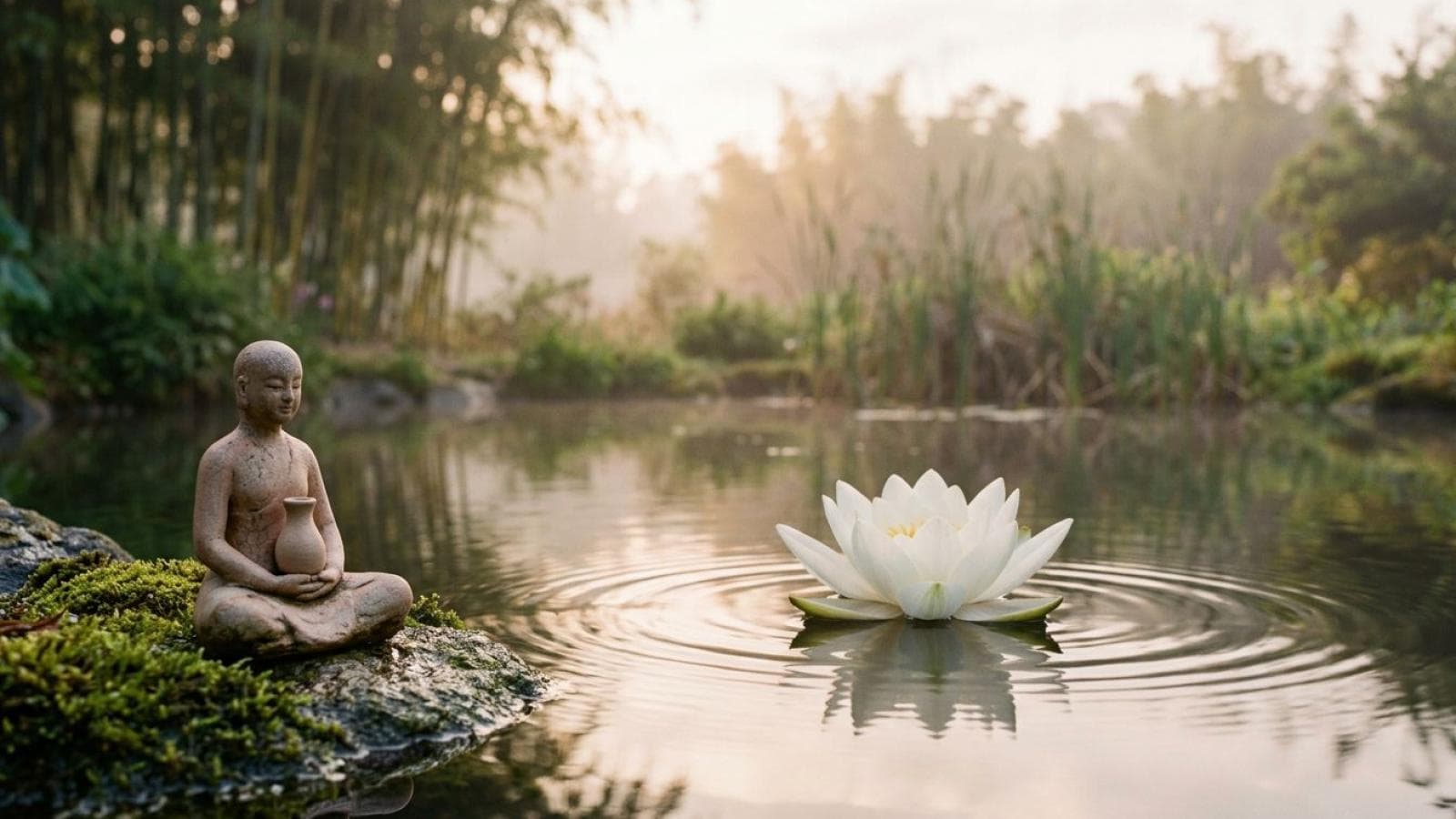
Many people who come to Zen Oasis with an interest in Kuan Yin are drawn first to her image: the serene figure holding a vase, often pictured with a lotus at her feet. But the deeper reason her teachings have endured for centuries isn't the imagery — it's the invitation underneath it. Compassion is not a performance for others. It starts within, and it starts with you.
Kuan Yin, also known as Guanyin, is a Bodhisattva in Mahayana Buddhism revered as the embodiment of compassion, traditionally believed to respond to suffering with boundless kindness. Her name is often translated as "she who hears the cries of the world" — a description that points to her defining quality: deep, attentive listening, offered without judgment.
Kuan Yin's teaching centers on compassion because compassion, in this tradition, isn't treated as a soft or secondary virtue. It's treated as a strength — the capacity to stay open-hearted toward suffering, including your own, instead of hardening against it. That distinction matters. Hardness looks like strength from the outside, but it usually costs more than it protects.
If you'd like to go deeper into her full teachings — the symbolism of the lotus, the practice of loving-kindness, and living with mindfulness — our companion piece on the teachings of Goddess Kuan Yin covers that ground in more detail.
Across East Asia, Kuan Yin is often depicted holding a willow branch and a vase of pure water, symbols associated with healing and the gentle removal of suffering. She isn't portrayed as distant or unreachable — she's portrayed as present, attentive, and willing to meet suffering exactly where it is, rather than waiting for it to resolve itself first. That same willingness to meet things as they are, rather than as we wish they were, is at the heart of what her teaching asks of us.
Compassion begins within because self-judgment quietly undermines every other form of kindness you try to practice. It's a common pattern: someone offers patience, forgiveness, and understanding to friends, family, even strangers, while reserving none of it for themselves.
Kuan Yin's teaching reverses the usual order. Instead of "earn compassion by giving it to others first," her wisdom suggests the opposite sequence: the compassion you're able to offer the world is shaped by how much you've learned to offer yourself. A well that's never allowed to refill eventually runs dry, no matter how generous the intention behind it.
This isn't a call to self-indulgence or ignoring the needs of others. It's a recognition that self-compassion and compassion for others aren't in competition — they come from the same source, and depleting one eventually depletes the other.
It also helps to notice how often self-criticism disguises itself as motivation. Many people believe that being hard on themselves is what keeps them disciplined or productive — that if they stopped judging themselves so sharply, they'd lose their edge. Kuan Yin's teaching challenges that assumption directly. Harshness rarely produces lasting change; it produces exhaustion. Compassion, offered consistently, tends to produce something steadier.
Self-compassion in daily life rarely looks dramatic. It shows up in small, repeatable choices about how you speak to yourself and how much room you allow for being imperfect.
None of these require elaborate ritual or spiritual training. They require noticing the moment self-criticism arrives, and choosing — deliberately, sometimes clumsily at first — a gentler response instead.
It's worth adding that self-compassion isn't the same as lowering your standards or avoiding accountability. You can hold yourself to something and still speak to yourself kindly while you work toward it. The two aren't opposites — in fact, people tend to sustain effort longer when the inner voice guiding them is patient rather than punishing.
Gentler self-talk is a practical starting point because it's the layer of experience you have the most direct access to, moment by moment. Most people don't consciously choose harsh inner narration — it runs quietly in the background, often inherited from old expectations or comparisons that no longer serve them.
Over time, this shift in tone tends to soften how you treat other people too — not because you're trying harder to be kind, but because harshness toward yourself and harshness toward others usually travel together.
A useful test is to notice whether you'd ever say your inner monologue out loud to someone you cared about. If the answer is no, that's a clear signal the words deserve softening — not because the underlying concern is wrong, but because the tone attached to it is doing more harm than the concern itself.
Making room for rest without guilt is one of the more overlooked expressions of self-compassion, especially for people used to measuring their worth by output. Kuan Yin's imagery — calm, seated, unhurried — is itself a quiet counterpoint to the belief that stillness has to be earned.
Rest doesn't need to be scheduled around exhaustion or justified by how much you've already accomplished. A few minutes of quiet in the morning, a walk without a destination, an evening without an agenda — these small pauses matter on their own terms, not only as recovery from busyness.
Many people only allow themselves to rest once they feel they've "earned" it through enough output. Kuan Yin's imagery suggests a different order: stillness isn't the reward at the end of effort, it's part of what makes sustained effort possible in the first place. A person who never rests isn't more compassionate toward their responsibilities — they're simply running on a deficit that eventually shows up somewhere.
If Kuan Yin's message of compassion feels like something you'd like to explore more personally, a reflective reading offers a gentle way in.
Explore Kuan Yin Oracle Reading at Zen OasisThe lotus is one of Kuan Yin's most recognisable symbols because it grows up through muddy water into a clean, unstained blossom — a reminder that difficult conditions don't disqualify you from eventually finding clarity and peace. It's a slow image, not a dramatic one, and that's part of its wisdom.
Self-compassion tends to work the same way: gradually, imperfectly, without a fixed timeline. You don't need to have "arrived" at peace with yourself before you're allowed to practice being kind to yourself. The practice and the progress happen together, the way the lotus rises through the water it grew from rather than despite it.
A Kuan Yin Oracle Reading at Zen Oasis is offered as a reflective guidance practice, not a prediction or a diagnosis of what's wrong with you. It's a way of pausing, asking an honest question, and receiving a perspective that can help you notice patterns you might otherwise move past too quickly.
Guided by Konchok Yangchen, founder of Zen Oasis and an Intuitive Healer, Psychic Medium, Oracle Reader, and Holistic Counsellor, these sessions are grounded in the same spirit as Kuan Yin's teachings: gentle attention, without judgment, offered at whatever pace feels right for you. Readings are available in person at the Zen Oasis studio in Andheri West, Mumbai, and online for those who prefer remote sessions.
It's worth being clear about what an oracle reading is not. It is not a medical or psychological assessment, it does not diagnose any condition, and it does not offer certainty about future outcomes. It's a reflective tool — one lens among many you might use to think through what compassion could look like in your own life right now.
Simple daily practices inspired by Kuan Yin's teaching don't require special training or elaborate ritual — they ask for consistency more than intensity.
These practices work quietly, over weeks and months rather than overnight. Kuan Yin's wisdom has never been about instant transformation — it's about a steady, patient return to compassion, again and again, especially on the days it feels hardest to offer yourself.
Self-compassion feels genuinely difficult for people who learned early that self-criticism was the price of belonging, achievement, or safety. If that's familiar, it's worth knowing that this isn't a personal shortcoming — it's a learned pattern, and learned patterns can shift, even slowly, with consistent practice.
On days when kindness toward yourself feels almost impossible to access, a smaller ask can help: rather than "be compassionate toward yourself," try "be slightly less harsh than usual, just for today." Lowering the bar this way keeps the practice honest rather than aspirational, and small, repeated shifts tend to compound over time in a way that a single dramatic effort rarely does.
Curious what a Kuan Yin Oracle Reading might reveal about the compassion you're ready to extend to yourself?
Book a session at Zen OasisIt means that the ability to genuinely offer compassion to others depends on first extending that same patience and understanding to yourself. Kuan Yin's wisdom treats self-compassion as the foundation, not an afterthought, of compassion for the wider world.
No, a Kuan Yin Oracle Reading is a reflective spiritual practice, not therapy, counselling, or a medical service. It offers perspective and gentle guidance and works well alongside — never as a replacement for — professional mental-health or medical care when that's needed.
No prior knowledge of Buddhism is needed. Kuan Yin's core teaching — that compassion, including self-compassion, has transformative power — is accessible and meaningful on its own, regardless of your background or beliefs.
The lotus grows through muddy water into a clean blossom, symbolising that peace and clarity can emerge gradually, even from difficult circumstances. It's often used as a reminder that self-compassion is a slow, ongoing practice rather than something to achieve instantly.
Yes, Kuan Yin Oracle Readings at Zen Oasis are available both in person at the Andheri West studio in Mumbai and online, so distance doesn't have to prevent you from exploring this practice.

Konchok Yangchen
Konchok Yangchen is an Intuitive Healer, Psychic Medium, Oracle Reader, and Holistic Counsellor, and the founder of Zen Oasis Wellness Center.
Related
Spiritual Teachings September 2026
A compassionate look at the dark night of the soul — what it is, how it differs from a mental-health crisis, and how to move through it with patience.
Read More
Spiritual Teachings July 2026
Goddess Kuan Yin, the Bodhisattva of Compassion, teaches that compassion begins within. Explore her core teachings on loving-kindness, deep listening, mindfulness, and how to bring her wisdom into everyday life.
Read More